This is mostly for Mom and Dad because they are planning a trip to Peru and there are some interesting customs you might not anticipate before coming. First and foremost, the standard greeting in Peru is a kiss on the cheek, generally the right cheek. It’s a bit of an acquired skill – awkward kisses and head bobs are bound to happen, although my helpful tip of right cheek (not given to me…) should eliminate some of those moments. This is only for new friends by the way – do not kiss employees of restaurants or people selling things. Pretty self-explanatory but you never know. Also, when you enter a room you need to greet EVERYONE in the room or it is considered rude. Even if there are 10 people in the room, it’s customary. Same with leaving – you say goodbye (adios, nos vemos, ciao…all are acceptable – tambien con un beso) to everybody. This applies to conversations in town and such too – even if you talk to someone for 30 seconds (NOT likely) you need to greet them and then give them a kiss again when you leave. Oh, por los hombres, it’s a handshake if between two men.
With food, lunch is the biggest meal of the day, followed by breakfast and then dinner which is usually pretty small. Lunch usually consists of a soup, a main course, some sort of side dish, frequently a dessert, and a drink after (not during). And you will hear "provecho" or "buen provecho" ALL the time - it basically means have a good meal but can also be used as a sort of goodbye, enjoy, have a nice time... It’s pretty normal to take a long drink after most meals like a mate (tea), hot milk, or sometimes coffee. Also, it is one hundred percent acceptable to begin eating once you are served, its considered kind of weird if you just sit there waiting (also, note: no conversation is really off-limits and the concept of political correctness doesn’t exist here – don’t take things offensively because they are not meant to be offensive at all [other note - physical appearance can become your nickname; if a Peruvian calls you chinita, gordita, flacita, lindita, etc...not meant to be offensive and is extremely common]). Although I’ve probably already made this clear, family relationships and relationships in general are extremely important to Peruvians, and honestly what is more deserving of importance? People make friends easily and maintain them for a long time, and its very common for people to stop by their friends’ houses or workplaces to chat and fill each other in. I really love this aspect of the culture - I have long felt that the people in your life are the most important parts of it, and it seems like I have landed in a place where everybody feels the same way. It’s really very wonderful.
Que más....transportation-wise most people walk everywhere because Urubamba is so small, but if you don't want to walk you can take a moto-taxi which is basically a motorized bicycle with a little cab attached on the back. You can even find some with decorations or weird things like blacklights in them - one of the local mototaxis is Batman-themed even. There are plenty of other little anomalies Americans might not immediately understand, but I think to try and explain them all would be a little absurd. In general, family is very important, odd little societal rules are not, and if you are ten minutes late to something, it’s not the end of the world.
La vida es buena.
Posted by Hannah Arnold
Thursday, June 2, 2011

Wednesday, June 1, 2011
La Salle
 |
| Emily selling organic yogurt and manjar at the market |
The market in Urubamba (on market days), is ginormous! It covers at least a block-wide radius, if not more, including a 3-story warehouse full with vendors. Apparently all the vendors come from the communities around Urubamba, to sell their products. All types of trinkets, grains, bread, fresh fruit/veggie/meat, etc. can be found here, and it's an experience to just walk around and see what everyone has. La Salle has a little space outside of the warehouse, and there, we sell what's ripe and ready. People come to the market at 7 for the freshest items, and the produce generally runs out by noon. Yesterday, Emily and I sold tomatoes ("¡uno cincuenta por kilo!" - 1.50 soles per kilo of tomatoes), and it was pretty cool. The gente would come, ask about the price, ask for a set price/weight, and we would help them. A custom here, is that if they're exactly at, say one kilo, then they want to "aumentame", or add some more (for free). This happens especially with the older women of Urubamba, and if they ask for it, you just give them a smaller, slightly damaged tomato for free. That's the market!
In the greenhouse, we do weeding around the plants and generally prepare the ground to grow really, really good organic fruits + veggies. (organic strawberries are Ah-mazing!) There are baby pigs, baby cows, regular/gigantic sized cows (only females to produce milk, they sell the males). La Salle produces organic: tomatoes, strawberries, lettuce, beets, peppers, milk, yogurt, cheese, etc. It's pretty cool!
Last week, Chris K and I had the pleasure of making liquid fertilizer. It consisted of: cow/chicken feces, fish/chicken heads, chicken guts, water, chicha (corn beer), yeast, corn bits, sugar - it gets to sit for three months and ferment!
 |
| Chris K. and Ameriko with the finished liquid fertilizer |
711 School
So after teaching all three classes for several weeks now, I think I can comment on how things are. All the students have a uniform, which consists of tan button down shirts with epaulets and matching tan pants (sometimes with a hat), and then a sweater if they're cold. All the students are super cute - upon walking into the school, we're immediately surrounded by students excited to see us (calling out "¡Profe!", short for profesor), and in some cases, I'm called "ProfeDavid." It's adorable :)
 |
| ProfeEmily with the 6th grade students |
Emily and I are teaching 3 different 6th grade classes, the oldest in 711. What's interesting is how each of the 3 classes differ (mostly) based on the teacher. In 6A, the profesora is really strict, and the class is super quiet as a result. In 6B, the teacher is pretty chill and nice, and the class is really energetic and fun to teach. In 6C, the teacher seems good…but when when Emily and I taught his class for the first time, he kinda dipped out on us for all of the class, except for the first ten minutes. Read: Emily and I had to control one of the more inherently rowdy classes by ourselves (not that bad but still). Regardless of the class dynamic, I love teaching these kids, and I think that the remaining weeks are going to be excellent. Apparently, the kids in C (who seem to be the most misbehaved kids per each grade) stay in C all throughout their elementary school career. Ex: 5C students go into 6C, so it's a never ending cycle of fostering bad behavior (of sorts). I don't approve of it, but there's not much we can do in that regard. In terms of getting their attention, the students love games where they get to compete (usually for points), and they love drawing. Thus, we've been building these two activities into our lesson plans in different ways, and it helps us make sure that they're learning the material as well.
Posted by David Chou
Posted by David Chou
Sunday, May 22, 2011
Saqsaywaman
Before our group of 11 went off to Urumbamba we stayed in Cuzco (a larger city about an hour away from Urumbamba) with the 9 Cuzco volunteers and visited various ruins in the area, the most impressive being Saqsaywaman, which have been said to be anything from an Incan fortress to a temple, although the temple hypothesis has garnered the most evidence. From above, the ruins are zigzagged, a tribute to lightning.


Posted by Brynne Sekerak

Before we got to the ruins we happened upon a grizzled farmer and his pack of llamas, which he allowed us to photograph as he stood off to the side. We hiked through the ruins, many of us gasping for air at the smallest incline as we have yet to acclimate to the altitude. It wasn't until we reached the foot of the giant walls that we realized the magnitude of what the Incas had done... huge boulders that towered over the tallest in our group, each perfectly aligned with the next, each stone's protrusion snuggly set into another's indentation.

The day before the ruins we visited the enormous, alabaster Jesus that watches over Cuzco, his arms stretched wide as if embracing the city. At his feet vendors sold alpaca hats, dark stone miniatures of the statue, and Incan crosses. There was also a woman with a llama (possibly an alpaca, I have yet to gain enough experience with the two to tell the difference) who encouraged our group to take pictures with her. This has happened countless times in our week here- Peruvian women in traditional garb canvassing the plaza for gringos who want a culturally “authentic” picture, older women sitting perceptively next to ruins, spinning alpaca fur into yarn. What seemed at first to be a kind gesture towards foreigners revealed itself to be a practice in entrepreneurship- after a picture is taken the women will ask for money for their efforts.
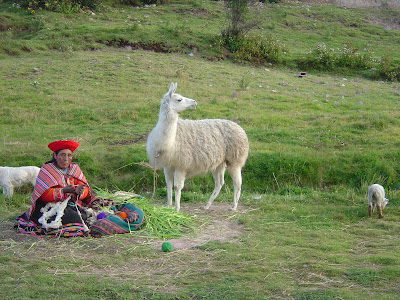
However breathtaking any of the ruins or monuments, the view of the mountains as well as Cuzco nestled in the valley is indisputably the most beautiful part of the trip thus far.


The day before the ruins we visited the enormous, alabaster Jesus that watches over Cuzco, his arms stretched wide as if embracing the city. At his feet vendors sold alpaca hats, dark stone miniatures of the statue, and Incan crosses. There was also a woman with a llama (possibly an alpaca, I have yet to gain enough experience with the two to tell the difference) who encouraged our group to take pictures with her. This has happened countless times in our week here- Peruvian women in traditional garb canvassing the plaza for gringos who want a culturally “authentic” picture, older women sitting perceptively next to ruins, spinning alpaca fur into yarn. What seemed at first to be a kind gesture towards foreigners revealed itself to be a practice in entrepreneurship- after a picture is taken the women will ask for money for their efforts.

However breathtaking any of the ruins or monuments, the view of the mountains as well as Cuzco nestled in the valley is indisputably the most beautiful part of the trip thus far.

Posted by Brynne Sekerak
Sunday, May 15, 2011
Peruvian Politics
From what I've gleamed from my host family, the next few years of Peruvian politics will be a bit rough. The current president has done a good job, raising the country's economic state, but presidential terms only last 5 years, and the election is this June 5th. The two candidates are Keiko and Ollanta. Choosing between the both is described as choosing between the lesser of two evils (los dos son malo y malo). Keiko is the daughter of a past dictator of Peru, who is currently banished from the country. If elected, she has clearly said that she's going to let her father back into the country, so who knows. Ollanta is described as a Hugo Chavez-like character. Thus, no one in Peru really knows who to vote for, and unfortunately, voting is mandatory here. Elections are on June 5th, so we'll see how the country reacts.
Posted by David Chou
Posted by David Chou
Saturday, May 14, 2011
Customs (what to do in Peru)
Now that I've been in Peru for a few days, I feel like I can comment on a few customs here that differ from the US.
Posted by David Chou
- In greetings, there are two different customs. When greeting guy to guy, you shake hands, as per usual. When greeting a woman, regardless of your gender, you kiss their right cheek. When entering a room full of people, it's customary to greet everyone in the room, otherwise it's rude.
- In eating, if people are served before you, it's customary for them to start eating immediately, otherwise it's considered rude to the chef.
- In using el baño, you have to put used toilet paper into the trashbin instead of the toilet - I don't think the septic system can handle it.
- In speaking, Peruvians tend to use "cutesy Spanish" quite a bit. This means that they add an "-ito" or "-ita" to lots of words, which basically means little (word). For instance, "perro" is dog, and "perrito" is little dog. Usually meant in an affectionate manner.
- In habits, at least what I've experienced from my host family, if there's a situation in which you can't really do much, you kinda shrug your shoulders and say "oof-e"
- In traffic customs, you do not get the right of way. If you get in the way of a car, the car will accelerate, instead of slowing down. Thus, crossing the streets in Cuzco is kind of like frogger - cross the streets when it's clear, and hope no one will clip you.
Posted by David Chou
Wednesday, May 11, 2011
Live from New York!
So here I am, sitting in JFK airport for eight whole hours, waiting to get onto a flight to Lima, Peru! I think all of us at JFK are all excited to see what's going to happen, and to just experience Peruvian life and culture! Personally, I'm a little nervous about the work we're going to do with ProPeru, and what the community's reception to us will be. As part of the environmental education group in Urubamba, I wonder if the community will accept the knowledge that we are trying to impart on them, or just reject it in favor of pre-existing customs. Regardless, I think that it's going to be a great experience, and from what I've heard, the community is pretty warm and accepting to Americans (I'm somewhat interested to see what the response to Asians will be). Since this is just a pre-Peru post, I'll keep it short, and in the future, I'll be focusing on my experiences with the culture, the people, and the food of Peru. I currently plan to photo-document just about everything I can, and there will be a slideshow going up on the site once I start taking pictures. For now, that's it! Peru in 10 hours.
Posted by David Chou
Posted by David Chou
Subscribe to:
Posts (Atom)